February 2006
Intermediate to advanced
826 pages
63h 42m
English
With the margin-top, margin-right, margin-bottom, and margin-left properties, you can specify a
margin for one side of an element. Margin size may be specified in any
of the accepted units of length. Negative values are permitted. Figure 19-4 shows examples of
adding margins to individual sides of an element. Note that the dotted
lines are a device to point out the outer edge of the margin and would
not display in the browser.
    h1 { margin-top: 3px; }
    h1 { margin-right: 20px; }
    h1 { margin-bottom: 3px; }
    h1 { margin-left: 20px; }
Percentage values are also permitted, but be aware that percentages are calculated based on the width of the parent element. If the parent element gets narrower (perhaps as the result of the browser window resizing) the margins on all sides of the child elements will be recalculated.
Margins may also be set using the keyword auto, which allows the user agent to fill in
the amount of margin necessary to fit or fill the containing
block.
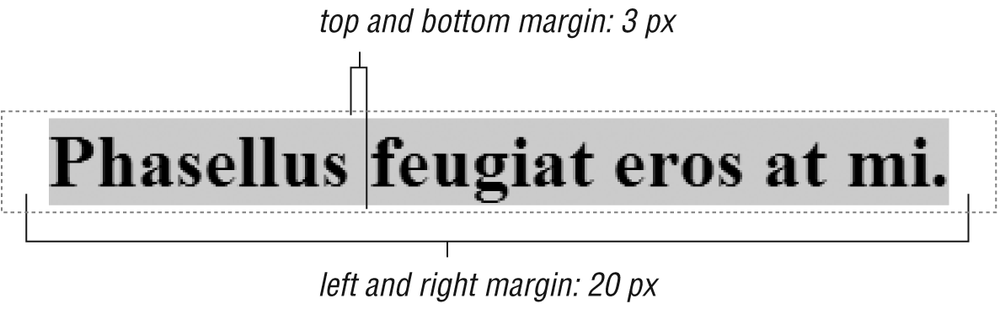
Figure 19-4. Individual margin settings
The proper way to horizontally center an element in CSS is to
set the left and right margins to auto. This technique (as well as the
workaround required for Internet Explorer in anything but Standards
mode) is addressed in Chapter
24.
Read now
Unlock full access


 O’Reilly covers everything we've got, with content to help us build a world-class technology community, upgrade the capabilities and competencies of our teams, and improve overall team performance as well as their engagement.I wanted to learn C and C++, but it didn't click for me until I picked up an O'Reilly book. When I went on the O’Reilly platform, I was astonished to find all the books there, plus live events and sandboxes so you could play around with the technology.I’ve been on the O’Reilly platform for more than eight years. I use a couple of learning platforms, but I'm on O'Reilly more than anybody else. When you're there, you start learning. I'm never disappointed.I'm always learning. So when I got on to O'Reilly, I was like a kid in a candy store. There are playlists. There are answers. There's on-demand training. It's worth its weight in gold, in terms of what it allows me to do.